

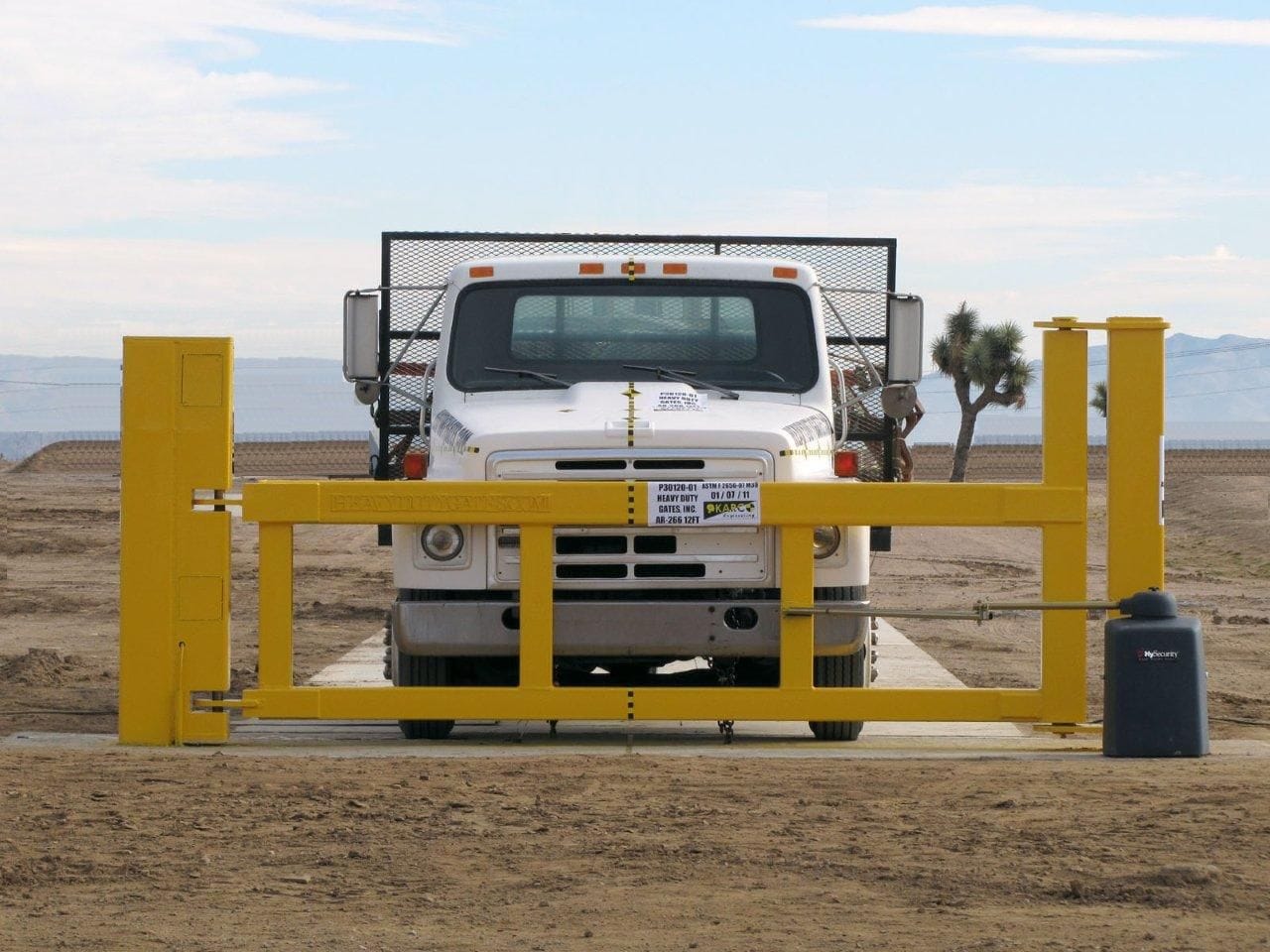
Crash Testing Vehicle Barriers to ASTM F2656 for Government and Military Sites
A vehicle barrier that has not been independently crash tested is a structural assumption, not a security commitment. At government facilities, military installations, embassies, and critical infrastructure sites, the difference between a tested and an untested barrier is the difference between a documented performance guarantee and a product that may or may not stop a hostile vehicle under real conditions. Crash testing vehicle barriers removes that uncertainty by subjecting every system to controlled, repeatable, independently verified impact scenarios before it is ever installed at a protected site.
This matters because the consequences of barrier failure at a high-security site are not limited to property damage. A breach at a military base, a federal building, or a power generation facility can result in casualties, mission disruption, and national security implications that no after-the-fact response can fully address. The crash test record is the only objective mechanism available to security planners that confirms a barrier will perform when it is needed.
What Crash Testing Actually Measures
Crash testing vehicle barriers is defined as the controlled process of subjecting a barrier system to a standardized vehicle impact at defined speed and weight conditions, then measuring and rating the system’s ability to stop the vehicle and limit penetration beyond the barrier line. The test does not evaluate aesthetics, ease of installation, or manufacturer claims. It evaluates one thing: whether the barrier stops the vehicle within the defined penetration distance under the specified impact conditions.
The three variables every crash test measures are:
- Vehicle weight and classification: Tests are run against defined vehicle classes ranging from small passenger cars through medium-duty trucks weighing up to 15,000 pounds. The vehicle class determines which threat the barrier is rated to stop.
- Impact speed: Expressed in miles per hour at the point of impact. Higher speed tests represent more energetic threats and require greater structural performance from the barrier.
- Penetration distance: How far the vehicle travels beyond the barrier line after impact. This is the most operationally significant measurement because it directly determines the standoff distance the barrier provides between the threat vehicle and the protected structure or personnel behind it.
These three variables combine to produce the barrier’s certified rating, which gives security planners an objective, comparable basis for selecting systems appropriate to their specific threat environment.
The Standards That Govern Certification
Two primary frameworks govern crash testing and certification for vehicle barriers at US government and military sites. Understanding both is essential for anyone specifying crash rated vehicle barriers for regulated procurement.
ASTM F2656, defined as the American Society for Testing and Materials standard test method for crash testing vehicle barriers, is the current US benchmark. It uses an M-rating system combining vehicle class and penetration outcome. An M50-P1 rating means the barrier stopped a 15,000-pound truck at 50 mph and limited penetration to one meter or less. The penetration rating matters as much as the speed designation: an M50-P4 barrier stopped the same vehicle at the same speed but allowed far greater penetration. For sites where standoff distance is critical, the P-rating determines operational suitability.
DOS SD-STD-02.01, issued by the US Department of State Office of Diplomatic Security, uses K-ratings: K4, K8, and K12, corresponding to a 15,000-pound truck at 30, 40, and 50 mph. K12 is equivalent to M50, but the two standards measure penetration from different reference points. Direct comparison requires confirming which version applies.
The DoD Anti-Ram Vehicle Barriers List, maintained by the US Army Corps of Engineers Protective Design Center, is the authoritative procurement reference for military and federal sites. Inclusion requires physical testing at a certified facility, validated documentation, and penetration no greater than P3. A barrier on this list has met a higher evidentiary standard than one that merely claims compliance.
Why Engineered Ratings Are Not Equivalent to Tested Ratings
An engineered rating means a barrier has been designed and modeled to meet a crash test standard based on engineering calculations, computer simulations, or extrapolation from related tested products, but has not been physically crash tested as part of a crash testing vehicle barriers evaluation. For commercial applications with lower threat profiles, an engineered rating may be acceptable. For government and military sites, it is not.
The distinction matters for three reasons:
- Physical testing reveals failure modes that engineering models cannot predict. Foundation interaction, soil conditions, and connection hardware behavior under dynamic load often perform differently in live tests than in simulations.
- Regulatory requirements for government and military facilities mandate physical test certification. An engineered rating not appearing on the DoD Anti-Ram Vehicle Barriers List will not satisfy procurement requirements, regardless of the engineering analysis quality.
- Liability and audit exposure differs significantly. A crash rated barrier with documented physical test results provides a defensible procurement record. An engineered rating provides only an engineering opinion.
For sites managing compliance with UFC (Unified Facilities Criteria) requirements from the US Army Corps of Engineers or State Department diplomatic security standards, the physical test record is the standard, not the alternative.
How Active Vehicle Barriers Are Tested and What That Means for Operational Sites
Active vehicle barriers are defined as powered barrier systems designed to control vehicle access at entry and exit points, including wedge barriers, drop arm barriers, crash-rated gates, and rising bollards, all of which can be mechanically raised or lowered to permit or deny vehicle passage. Crash testing vehicle barriers in active configurations introduces an additional variable that static barriers do not face: the system must perform in the raised, deployed position while its mechanical components remain intact enough to allow subsequent operation.
For operational sites, this matters because access control points are among the highest-threat locations in any perimeter. A government facility or military installation that requires controlled vehicle entry cannot afford a barrier that passes a crash test in a static configuration but fails mechanically after a single high-energy impact. The process of crash testing vehicle barriers in their active, deployed state provides documented performance under real impact conditions, not just in an idealized test configuration.
BSP’s active vehicle barrier line includes crash-tested wedge barriers, drop arm systems, and anti-ram crash gate barriers, each independently tested and listed on the DoD Anti-Ram Vehicle Barriers List. For a detailed breakdown of how wedge barriers perform mechanically under high-energy impact, the wedge barrier guide covers operational specifications, deployment configurations, and site integration requirements.
Reading a Crash Test Rating for Procurement Decisions
A crash test rating contains more information than it initially appears to. For security planners and procurement officers specifying an anti ram vehicle barrier for a regulated site, knowing how to read the rating correctly prevents misspecification and compliance failures.
The rating components to evaluate are:
- Vehicle class: M designations (M30, M40, M50) identify the test vehicle weight and speed. Higher M numbers represent more energetic impacts and greater structural demand on the barrier.
- Penetration rating: P1 (one meter or less) through P4 (greater than 23 meters). P1 is the highest performance level. For sites where protected personnel or structures are close to the barrier line, P1 is the only operationally appropriate rating.
- Test standard version: ASTM F2656-19 and later measure penetration from the leading edge of the barrier. Earlier versions and DOS SD-STD-02.01 measure from different reference points. When comparing products across different test reports, confirm that penetration measurements use the same reference point.
- DoD list inclusion: Confirm the specific product configuration and installation method that achieved the rating matches what is being proposed for the site. A rating achieved with a different foundation type, post spacing, or connection hardware does not transfer to a different installation configuration.
For sites requiring passive protection at secondary access points alongside active barriers at primary entry, BSP’s passive vehicle barrier line covers crash-rated cable barriers, bollards, and portable deployment systems, all independently tested to ASTM F2656.
The Procurement Consequences of Installing Uncertified Barriers
Installing an uncertified or under-rated barrier at a government or military site carries consequences beyond the security risk itself. Compliance with UFC standards, State Department diplomatic security requirements, and applicable federal physical security mandates requires that barriers meet documented performance thresholds verified through crash testing vehicle barriers. An uncertified installation creates audit exposure, potential contract non-compliance findings, and liability in the event of a breach.
Beyond compliance, there is the operational reality: a vehicle-borne threat does not adjust its speed or weight to match what an uncertified barrier was modeled to stop. The crash test record is the only evidence that a barrier performs under real conditions. For government and military procurement officers, specifying crash rated vehicle barriers with physical test documentation and DoD list inclusion is not a bureaucratic requirement. It is the minimum standard of care for the personnel and assets the barrier is protecting.
Certified Performance Is the Only Acceptable Standard for High-Stakes Sites
Crash testing provides the verified performance data that distinguishes true security barriers from systems that only appear secure in crash testing vehicle barriers. For government facilities, military installations, and critical infrastructure sites, independently tested barriers are essential for ensuring the perimeter performs under real vehicle-borne threats.
At Black Security Products, we supply independently crash-tested active and passive vehicle barriers, access control systems, and perimeter security solutions listed on the DoD Anti-Ram Vehicle Barriers List and tested to ASTM F2656 and DOS SD-STD-02.01 standards. BSP systems are trusted across government, defense, and critical infrastructure environments where proven performance and long-term reliability are critical.