

High Security Perimeter Fencing Lead Times: Planning Large-Scale Projects With SecureMesh Alpha
Large-scale security projects fail more often from poor timeline planning than from product selection. SecureMesh Alpha is a high security perimeter fencing system built around a 3-rail wire mesh design, and specifying it for a large-scale project involves design review, manufacturing, and phased installation, each carrying its own lead time that project managers need to account for well before a site is ready for fencing crews. Underestimating these timelines is one of the most common reasons large infrastructure and government projects fall behind schedule.
This guide breaks down the typical lead time stages for a SecureMesh Alpha installation, using its specific construction details as the reference point for what large-scale planning actually requires from initial design through final installation.
Why SecureMesh Alpha Lead Times Differ From Standard Fencing
Small fencing jobs can often be quoted, ordered, and installed within a matter of weeks. Large-scale projects specifying high security perimeter fencing like SecureMesh Alpha operate on a different timeline entirely, since the product’s engineering requirements demand custom review, coordinated material procurement, and phased installation across a large footprint.
Common factors that extend project timelines include:
- Site-specific engineering review for terrain, soil conditions, and wind load requirements
- Custom panel configurations for irregular perimeter shapes or grade changes
- Extended manufacturing runs for large material quantities
- Coordination with other contractors working on the same site
- Government or regulatory approval steps before installation can begin
Projects that fail to account for these factors early often face costly delays once installation crews are already mobilized and waiting on materials, which is why early alignment with a provider’s design and engineering services matters as much as material selection.
What SecureMesh Alpha’s Construction Means for Planning
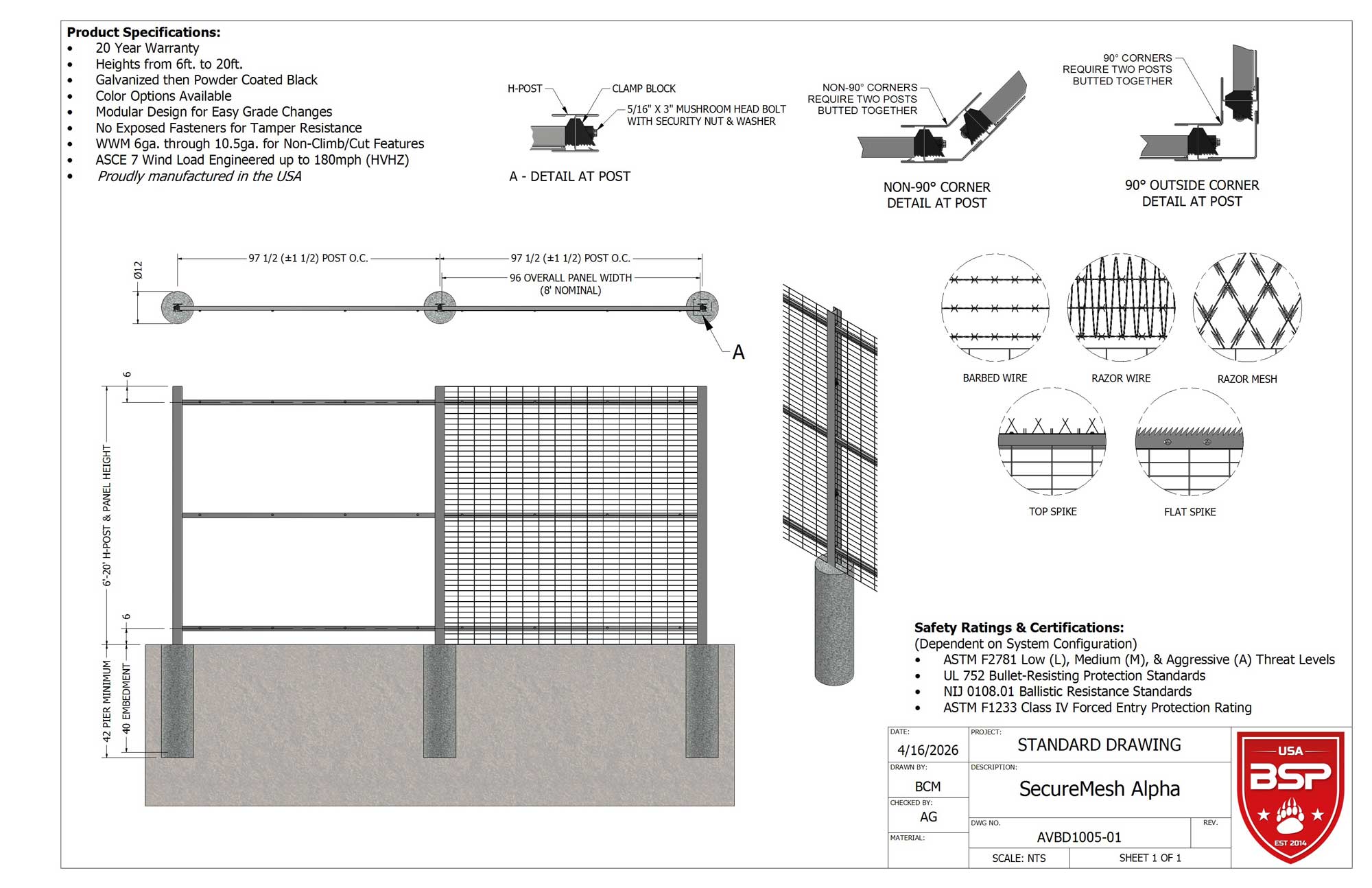
SecureMesh Alpha combines a 3-rail wire mesh system with non-threat-facing connection hardware, which means the manufacturing and installation process carries specific requirements that project managers should factor into their timeline from the outset.
| Product Specification | Planning Impact |
| Heights from 6 ft. to 20 ft. | Taller configurations require additional engineering review |
| ASCE 7 wind load engineering up to 180 mph (HVHZ) | Sites in high-wind zones may need extended design validation |
| Galvanized then powder-coated finish | Adds coating and curing time before panels ship |
| WWM 8ga. and 6ga. mesh for non-climb and non-cut resistance | Gauge selection affects manufacturing lead time |
| No exposed fasteners for tamper resistance | Requires precise fabrication tolerances during production |
| Modular design for grade changes | Reduces field customization but requires accurate site surveying upfront |
Reviewing the full range of available fencing and barrier systems early in this stage helps confirm whether SecureMesh Alpha’s standard configurations meet site requirements or whether custom heights or hardware are needed from the start.
Stage One: Design Review and Site Engineering
Before any SecureMesh Alpha panels are manufactured, the project site needs a formal engineering review. This stage confirms terrain conditions, identifies underground utilities, and determines whether standard panel heights and modular grade-change sections will work for the site.
Design review typically includes:
- Site survey to document terrain, elevation changes, and access points
- Soil analysis to confirm foundation and post embedment requirements
- Wind load assessment, particularly for sites requiring HVHZ-rated engineering
- Review of existing utility markings to avoid conflicts during installation
- Confirmation of perimeter length, fence height, and any irregular boundary shapes
This stage alone can take several weeks on large projects, particularly when wind load conditions or complex terrain require additional engineering validation. Projects that fail to plan around these factors early often face delays once crews are mobilized, an issue explored further in the guide on threat assessments for perimeter security, which covers how planning gaps tend to surface once a project is already underway.
Stage Two: Material Procurement and Manufacturing
Once the design is finalized, material procurement and manufacturing begin. SecureMesh Alpha’s galvanized-then-powder-coated finish and non-exposed fastener design require dedicated manufacturing time, particularly for large orders or custom color specifications.
| Manufacturing Stage | Typical Timeline Impact |
| Raw wire mesh sourcing (8ga./6ga.) | Longer for large orders or specific gauge requirements |
| Panel fabrication and 3-rail assembly | Scales with total linear footage required |
| Galvanization and powder coating | Adds processing time before shipment, longer for custom colors |
| Quality control and tamper-resistance testing | Required before panels leave production |
| Packaging and shipment coordination | Timed to match phased installation schedule |
Project managers should request manufacturing lead time estimates early in the planning process, since large orders often need to be scheduled into a production queue rather than fabricated on demand.
Stage Three: Coordinating Installation Across a Large Perimeter
Installation on large-scale SecureMesh Alpha projects rarely happens all at once. Most projects are phased across multiple sections of the perimeter, which requires careful sequencing to avoid leaving gaps in security coverage during construction.
Key coordination considerations include:
- Sequencing installation to maintain a secured perimeter at all times
- Scheduling crews around other active construction on the same site
- Managing material delivery to match installation pace without overloading laydown areas
- Coordinating gate and access control installation with the broader security timeline
Perimeter security solutions deployed across large sites often require a dedicated project schedule that treats fencing installation as its own workstream rather than a final step tacked onto the end of construction. SecureMesh Alpha’s modular design for grade changes helps simplify field installation, but crews still need accurate survey data ahead of time to avoid on-site rework.
Common Causes of Delay in Large-Scale Fencing Projects
Even well-planned projects can face delays. Understanding the most common causes helps project managers build in realistic buffer time rather than working off an overly optimistic schedule.
- Late-stage design changes requiring re-engineering and re-manufacturing
- Underground utility conflicts discovered after installation begins
- Weather delays affecting foundation work or panel installation
- Permitting or regulatory approval delays for government and infrastructure sites
- Supply chain disruptions affecting raw material availability
Building buffer time into the schedule for at least two or three of these factors is a reasonable planning approach for most large-scale projects, particularly those involving government or critical infrastructure sites.
Planning Lead Times for Custom SecureMesh Alpha Specifications
SecureMesh Alpha is engineered for high-security applications, which means projects requesting non-standard heights, HVHZ wind ratings, or custom color finishes should plan for longer lead times than a standard 6 ft. configuration in a stock finish. High security perimeter fencing at this level of customization requires additional coordination between design and manufacturing before production begins.
Factors that specifically affect SecureMesh Alpha lead times include:
- Total linear footage required for the project
- Fence height, particularly configurations approaching the 20 ft. maximum
- HVHZ wind load engineering requirements for high-wind regions
- Coordination with other AT/FP systems being installed on the same site
- Government project timelines involving additional documentation and review steps
Early engagement with the manufacturer during the design phase, rather than after design finalization, typically produces more accurate lead time estimates and reduces the risk of last-minute schedule surprises.
Building a Realistic Project Timeline
Bringing all of these stages together, project managers should build a timeline that accounts for design review, manufacturing, and phased installation as distinct workstreams rather than a single combined estimate. A recent case study on data center perimeter security planning illustrates how this phased approach applies in practice, particularly for projects with strict operational uptime requirements that limit when installation work can occur.
Facilities operating under regulatory oversight should also factor in review timelines that extend beyond the fencing project itself. According to the Cybersecurity and Infrastructure Security Agency’s overview of critical infrastructure sectors, utility, communications, and government facilities often operate under heightened security requirements that can add formal review steps to project timelines, making early planning even more important for these site types.
Planning Ahead Prevents the Most Common Delays
High security perimeter fencing projects built around SecureMesh Alpha succeed or fail based on how realistically the timeline accounts for design review, manufacturing, and phased installation. Treating these as distinct stages, each with its own lead time, gives project managers a far more accurate schedule than estimating fencing as a single line item at the end of a construction plan. For large-scale projects specifying custom heights, wind ratings, or finishes, early engagement during the design phase remains the single most effective way to avoid the delays that most commonly derail fencing timelines.
Black Security Products works with project teams from the earliest design stages to build realistic manufacturing and installation timelines around SecureMesh Alpha, helping large-scale projects stay on schedule from initial engineering review through final installation.